propertySpecified in XML Serialization

What will be saved when an object of SomeDate class is serialized?

public class SomeDate
{
private short yearField;
private bool yearFieldSpecified;

public short Year
{
get
{
return this.yearField;
}
set
{
this.yearField = value;
}
}

[System.Xml.Serialization.XmlIgnoreAttribute()]
public bool YearSpecified
{
get
{
return this.yearFieldSpecified;
}
set
{
this.yearFieldSpecified = value;
}
}
}

The serialization code is:

private static void InitializeDateFile()
{
SomeDate oDate = new SomeDate();
oDate.Year = 1910;
oDate.YearSpecified = true;

XmlSerializer xmlSer =
new XmlSerializer(typeof(SomeDate));
XmlTextWriter writer =
new XmlTextWriter(@"SomeDate.xml",
Encoding.Default);
writer.Formatting = Formatting.Indented;
xmlSer.Serialize(writer, oDate);
writer.Close();
}

With oDate.YearSpecified = true;, the output is:

<SomeDate xmlns:xsi="http://www.w3.org/2001/XMLSchema-instance"
xmlns:xsd="http://www.w3.org/2001/XMLSchema">
<Year>1910</Year>
</SomeDate>

But without oDate.YearSpecified = true;, the output becomes:

<SomeDate xmlns:xsi="http://www.w3.org/2001/XMLSchema-instance"
xmlns:xsd="http://www.w3.org/2001/XMLSchema" />

Where is Year element?

Here I found the reason:

The XML Schema Definition Tool (Xsd.exe) occasionally generates the XmlIgnoreAttribute when creating classes from a schema file (.xsd). This behavior occurs because value types cannot be set to a null reference (Nothing in Visual Basic), but all XML data types can be. Therefore, the tool creates two fields when it encounters an XML type that maps to a value type: one to hold the value, and another, special field that takes the form of fieldnameSpecified, where the fieldname is replaced by the name of the field or property. Notice, however, that this special field is generated only when the schema specifies that the element need not occur (minOccurs = "0") and that the element has no default value. The XmlSerializer sets and checks this special field to determine whether a value has been set for the field or property. Because the special field must not be serialized, the tool applies the XmlIgnoreAttribute to it.

Good Videos (Taiji)

Although I have practiced Chen-style Taiji for several years, I did not learn Taiji Push-Hand.

From last month, I began to learn Push-Hand with Yang-style Taiji teachers. Their teaching also changed my feeling that Yang-style Taiji is eaiser than Chen-style. With good teachers around, I am confident that I can improve my health and Taiji skills from now on. :)

There are some good videos about Chen-style and Yang-style Taiji here. I save the link in this post for my later reference.

DateTime serialization in .NET 1.1 and 2.0

When a system is running in different time zones, we need pay attention to DateTime field, because .NET 2.0 web service is not compatible with .NET 1.1 web service in design for DateTime field.

.NET 2.0 DateTime uses two-bit flag to indicate time zone: Local, UTC, or unspecified (default)..NET 1.1 does not use that flag.

.NET 2.0 serializes DateTime with time zone information for “Local” and “UTC” DateTime object. There is no time zone for “Unspecified” DateTime object. By default, .NET program uses “Unspecified” DateTime value as local time. In distributed system across time zones, this may bring troubles.

.NET 1.1 always serializes DateTime with time zone.

Below is an example tested in our project:
--------------------------------------------------

public class DateTimeSample
{
private System.DateTime m_dtDateTime =
DateTime.Parse("08/10/1971");

public System.DateTime LocalTime
{
get
{
return m_dtDateTime.ToLocalTime();
}
}

public System.DateTime Default
{
get
{
return m_dtDateTime;
}
}

public System.DateTime UniversalTime
{
get
{
return m_dtDateTime.ToUniversalTime();
}
}
}

.Net 1.1 serialization:

<?xml version="1.0" encoding="utf-16"?>
<DateTimeSample xmlns:xsd="http://www.w3.org/2001/XMLSchema"
xmlns:xsi="http://www.w3.org/2001/XMLSchema-instance">
<LocalTime>1971-08-10T20:00:00.0000000-04:00</LocalTime>
<Default>1971-08-11T00:00:00.0000000-04:00</Default>
<UniversalTime>1971-08-11T04:00:00.0000000-04:00</UniversalTime>
</DateTimeSample>

.Net 2.0 serialization:

<?xml version="1.0" encoding="utf-16"?>
<DateTimeSample xmlns:xsi="http://www.w3.org/2001/XMLSchema-instance"
xmlns:xsd="http://www.w3.org/2001/XMLSchema">
<LocalTime>1971-08-10T20:00:00-04:00</LocalTime>
<Default>1971-08-11T00:00:00</Default>
<UniversalTime>1971-08-11T04:00:00Z</UniversalTime>
</DateTimeSample>

When a system becomes distributed …

When we build a system, normally we design a simple framework at first. Then we will add more features to it. When the system is growing bigger and distributed, you will find some weird and interesting bugs.

One example is about date time. When a system was designed at the beginning, the developers decided to use local time to save all the time fields, including “date of birth”. When the program was running locally, there was no problem. But when a call center using Windows Forms application became part of the system, a weird bug arose: some clients’ date of birth had one day difference between sub systems (e.g. 08/18/1966 in one database, but 08/19/1966 in another database). Because of wrong DOB, the clients could not pass credit check.

I spent the whole afternoon and evening yesterday to check code and logs, but I didn’t find any reason. Then before I went bed last night, suddenly I realized the bug was caused by time zone difference in computers.

For example, the business layer server is in “-5” time zone, but a Call Center agent’s computer is set to time zone “-4”. When the agent inputs DOB “08/18/1966”, the Call Center Windows Forms program will pass that date (“08/18/1966 00:00:00”) in local time format to business layer server. Because of time zone difference, the server will receive “08/17/1966 23:00:00” instead – one day difference occurs.

Some computers may have random time zone settings. The DOB field becomes messy.

A quick, temporary, logically (not physically) simple solution: to make all machines in same time zone. For the long term solution, the system should change to use UTC, not local time. That will require longer time to change database and code.

State Machine Workflow: Screencast

Although there are many webcasts or articles about MS Workflow Foundation, it is hard to find good stuff about state machine workflow. So when I found this good introduction of state machine workflow, I was quite happy to watch it several times. :)

Load Balancer and System.Net Connection Management

When you make first HttpWebRequest from you application to access a web site or web service, you will use this code:

WebRequest request = WebRequest.Create(url);
WebResponse response = request.GetResponse();


The process of creating a connection with remote application is complex. In order to improve connection speed for later web requests, .NET framework creates a connection pool for each URL. When a web response comes back, the connection is still available for other web requests with the same URL.

By default, the connection’s KeepAlive attribute is true. But the connection can not stay forever, of course. In .NET 2.0, you can define MaxIdleTime -- when the connection has been idle for more than MaxIdleTime, the connection will be closed by framework.

The logic looks good so far. But when a load balancer is involved, a problem may arise. Load balancer directs a request to a Web service and creates connection for the request. If the connection is idle for a period, the load balancer will break the connection without sending notification out.

Let’s suppose the load balancer breaks idle connection after 90 seconds. But on application server side, .NET connection pool keeps idle connection for 100 seconds (by default). When a new web request is sent at this point, an HTTP transport exception will be thrown.

So it is important to make sure the connection timeout settings. After contacting system administrator for load balancer setting, developer can set MaxIdleTime for the connection:

request.ServicePoint.MaxIdleTime = maxIdleTimeValue;

Please make sure the .NET connection MaxIdleTime must be smaller than the load balancer's max connection idle setting. In this way, .NET framework will create a new connection when the connection has been broken by load balancer.

Service Factory


Patterns & Practices group is making Service Factory to ease Service-Oriented programming in Visual Studio. Don Smith had an excellent webcast to demonstrate how to use Service Factory Visual Studio extension to develop ASMX and WCF solutions.

The Service Factory allows developer to write contract-first services easier (instead of current implementation-first development). Don Smith showed how to use XSD file to generate data contract classes and how to define service contract to generate web service classes.

.NET Guidance Explorer

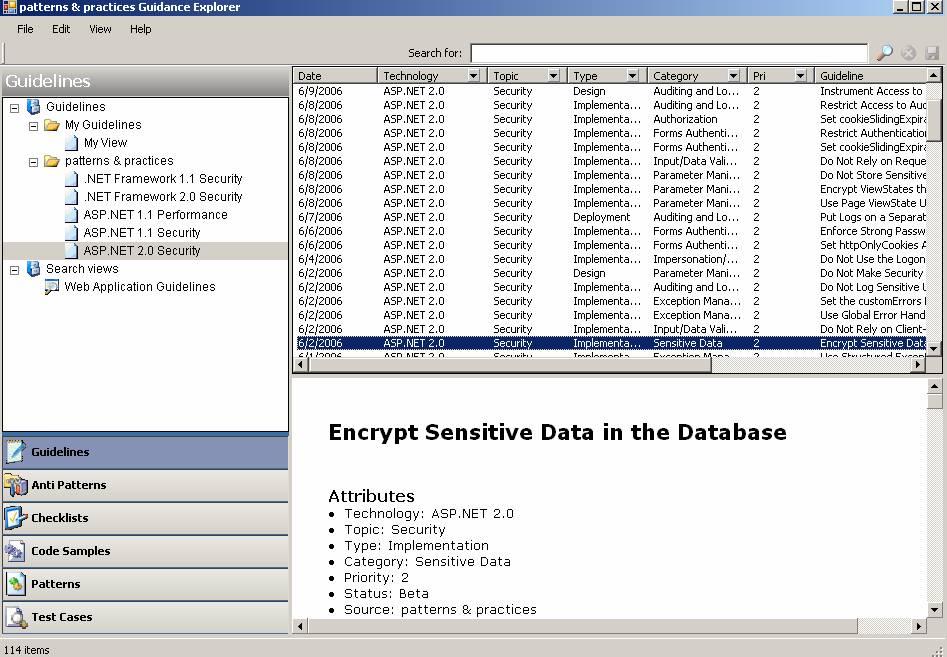
Although I have disks about .NET patterns & practices, a desktop Guidance Explorer is quite handy:


The only problem is that the explorer does not include enough topics at this point. The developing group is adding and releasing more content nearly weekly.

Is there an auto update feature in the explorer? Unfortunately, no.

Using I/O Completion Port (IOCP) to implement our own thread pool

Here I talk about another old but important technology for .NET server application.

Before we discuss thread pool, a concept should be clear: You can generate as many threads as you want in .NET code, but the default thread pool has at most 25 threads.

For a server application, it is normally necessary to use thread pool to leverage client requests, even on a single CPU computer.

1. Thread pool background knowledge

Creating thread is expensive: To create a thread, a kernel object is allocated and initialized, the thread's stack memory is allocated and initialized, and Windows sends every DLL in the process a DLL_THREAD_ATTACH notification, causing pages from disk to be faulted into memory so that code can execute. When a thread dies, every DLL is sent a DLL_THREAD_DETACH notification, the thread's stack memory is freed, and the kernel object is freed (if its usage count goes to 0).

Thread pool keeps some idle threads in suspended state to save time. At first, there is no thread in the thread pool. When the first request comes, a thread is created to process the request. If the request process takes long time (such as accessing web service), the thread enters sleeping mode at a certain time, the thread pool can create another thread to serve queued requests. When web service response comes back, the sleeping thread is woken up to continue the process. After the request is processed, the thread does not simply die, but serves other requests.

If we do not use thread pool, we will end up using one single thread to serve all client requests sequentially (for long-running request, the performance is terrible); or we create/destroy a thread for each client request, which is time consuming for large amount of requests.

2. Why do we need our own thread pool

By default, there are 25 threads in the thread pool for a .NET application. Normally, the .NET thread pool is OK if there are not many services running in the application and each request process is short. But if the application have many tasks to do (with several back ground threads, scheduler, many long-running requests), it is necessary to build our own thread pool.

3. How to build thread pool

Windows Server I/O Completion Port (IOCP) is a kernel queue that can be used for thread pool. The basic idea is to allocate a number of threads to wait on the queue. A request on the queue includes request data address that is supposed to indicate delegate value, so that the thread can run the delegated method.

You can read more about IOCP thread pool implementation in C# from Part I and Part II

The problem of the article is that the author did not show how to get the request data. You should use Target property of GCHandle to get the real .NET data back.

Microsoft Identity Integration Server

Last night, I attended MICSUG user group meeting. The topic of the meeting was about Microsoft Identity Integration Server (MIIS) to integrate user identities from different data sources. MIIS is a good server for a big company where some legacy systems or departments want to share user identity.

The picture below is an example of MIIS use case. MIIS developer can define attribute mapping for data sources (SQL server, flat file, Active Directory, etc) to import/export identity data.

The current version has limited ability to manage password though. It is understandable that many systems use hash code to store password, so that MIIS can not get original password out. MS is developing password management in next version.

The next version of MIIS can also support Extranet for B2B/B2C identity integration. InfoCard (CardSpaces) will also be supported. It sounds like MIIS will become a good middleware for a big company.

Web Service Host Application Implementation

I have been curious for a long time about how Web Service host application is implemented. After I build .NET web service assembly, how can Web Service host application receive request and call the correct method?

From the research I did on Web Service topics these days, I have a concrete idea about how to implement a Web Service host environment. How does ASP.NET platform process Web Service request is beyond my current ability. Here I only talk about the main steps for a normal Web Service host application to process Web Service request.

Reflection is the key for Web Service host application to work.

1. We define a Web Service class and Web Methods by using according attributes. When we deploy the assembly to the host application, the application uses reflection to load the assembly and initialize properties using those attributes:

Assembly assem = Assembly.LoadFrom(assemblyPath);
foreach (Type t in assem.GetExportedTypes())
{
foreach (MethodInfo info in
t.GetMethods(BindingFlags.Public | BingFlags.Instance)
{
if (info.IsDefined(typeof(WebMethodAttribute), false))
{
// Set according properties
}
}
}

Reflection is also used here to generate WSDL file by going through WebMethodAttribute.
2. When a SOAP request comes, the host application parses the SOAP packet to get class name, method name and parameter list.
3. The host application allocates an instance using the class name, either from instance pool or using a singleton
4. The host application finds the method by using method name and calls the method:

MethodInfo info = type.GetMethod(methodName);
object result = info.Invoke(instance, parameters[]);

5. Return the object in SOAP packet if there is no error; otherwise, return exception

The steps above are my simplest design of a Web Service host. I will consider WSE later.

Dynamic Code Compilation

Maybe you already know this old technology -- dynamic code compilation, but I didn't touch it until today.

Suppose we put code on production box, later we need trace a bug in production environment. Of course there is no Visual Studio installed on production box. How can we do? Sometimes it is too complex to build a testing project and upload to production box. What about building a generic editor with code compilation capability, so that we can put testing code in it and compile the source code dynamically without complex command line typing?

Another example is Application Server. It is a good feature to compile testing code inside the server environment for module's stress test.

Inside the editor, we can define our own format for DLL references. For example:

//@ref "DLL file name"

The editor compiles source code in these steps:
  1. Create an instance of CodeDomProvider CSharpCodeProvider (VBCodeProvider for Visual Basic)
  2. Provide CompilerParameters for compiler options, such as adding DLL references
  3. Compile source code using CompileAssemblyFromSource method of the CodeDomProvider
  4. Check CompilerResults
  5. Execute generated application if there were no errors

SoapHttpClientProtocol and XMLSerializer

I took it for granted that because .NET web service client sends SOAP request to invoke web service method, the client side should use SoapFormatter to serialize SOAP request parameters. Today I know I was wrong.

Actually the client side uses XMLSerializer (instead of SOAPFormatter) to serialize SOAP request content.

Why? Because SOAPFormatter (or BinaryFormatter) serializes all public, private data members and even methods to a stream, while XMLSerializer only serializes public data members. Web service is supposed to integrate separate applications in different platform (.Net, or Java, etc.), so it does not make sense to send private members and methods to the other side.

If you want to send the whole object to the other side, you should use .NET remoting where you can make use of SOAPFormatter or BinaryFormatter.

What I learned in Mid-Atlantic Code Camp in Reston

Yesterday I attended .NET Code Camp in Reston, VA. Before I went there, I had wondered how well it would be, because many good speakers went to TechEd 2006 in Boston. If this code camp had been scheduled days ahead of TechEd, maybe some TechEd speakers would attend the code camp to practice their topics. "Anyway, I will go there to have a look on this beautiful Saturday", so I went there in the morning.

According to the session schedule, some good speakers were not there of course, but I did find several good speakers on the list! :)

The schedule included five tracks: Web track, Data track, Smart Client track, Miscellaneous track, and Security track. There were no much stuff on WinFX (.NET 3.0). Below are the sessions I attended:

1) "Enterprise Library and Data Security": Gary Blatt was still humorous. It's pleasure to listen to his speech. He did not talk about Enterprise Library 2.0 though.

2) "Secure Click Once Smart Client Deployment": MS Regional Director - Brian Noyes' speech was full of exciting technology to me! :) He showed his broad knowledge on .NET platform. Actually, it was the first time for me to see a real "Click Once" (or Click Twice) deployment.

In his speech, Brian showed deployment and application manifest files for an assembly. Whenever an assembly is deployed, new manifest files will include hash code for its XML content, and application manifest file also includes hash code for DLL files. In this way, it is quite difficult for hackers to replace DLL files or to change manifest content.

On user side, Smart Client application runs code according to deployment server URL, so that user can run applications side-by-side deployed from QA server and production server.

It is impossible for me to write down all what I learned from this session. I will wait for his coming MSDN Online article about Secure Click Once Deployment.

3) "Refactoring: Why? When? How?": C# MVP Jonathan Cogley is also one of my favorite speakers (I attended two of his sessions :>). He did not prepare PowerPoint slides. What he did was to show in Visual Studio how to make existing code better for maintenace and performance purposes using refactoring techniques (Rename, Extract Method, Move Method, Introducing Explaining Variable, etc.) and tools (e.g. ReSharper, NUnit). To see a smart guy changing code step by step is really a good learning experience! :)

4) "Web Applications Security: Greatest Hits": Jonathan Cogley demonstrated SQL Injection and Cross-Site Script Attack in ASP.NET application, and how to change code to avoid attacks. Some concepts were not new to me, but I still got some good hints.

For example, we may separate input pages with HTML editor from other input pages. HTML editor accepts Java Script in the textbox, so we should disable Request Validation for that page. For other input pages, we should enable ASP.net Request Validation to avoid script attack.

5) "SQL Server Integration Services with Team Systems": Andy Leonard had planned to show Team system, but unfortunately his VPC died at that time. Instead, he showed us more exciting SSIS feathers. What surprised me in SSIS was its step-by-step debug capability inside Visual Studio.

Andy mentioned that DBA should be involved in Software Development Life Cycle to make system better. I totally agree with him. Nowadays, many systems are designed without DBA, Tester, even Developers being involved --- How can they develop the system without misunderstanding?

6) "Building Ajax Style Applications using ASP.NET 2.0 and Atlas": MS Regional Director Vishwas Lele showed some cool features of Atlas. He made it clear that Atlas does not use ASP.NET 2.0 Callback feature, it uses a special HTTP Handler to process JSON request directly without going through the whole ASP.NET page cycle.

Overall, although I did not see topics about latest .NET 3.0, I still learned a lot from this code camp and went back home happily! :)

.NET Application Server

"Application Server" has been a common buzz word in Java world for many years. J2EE Application Server hosts Java applications and provide environment for deployment, configuration, transaction, logging, session management, instance management, reporting, exception handling, load balancing etc. What application developer cares is mainly the application's business logic.

Application Server in Java world makes perfect sense, because Java runs on different operating systems. It is necessary to build a common environment to hold applications.

But in .NET world, "Application Server" is not well-known. We do not need Application Server in .NET, right? Yes or no.

Yes. The main reason is that .NET is built upon Windows system, so that .NET can use features provided by Windows System (e.g. Transaction, Logging) directly.

No. We still need an integrated environment for Enterprise software. That is the reason why MS Enterprise Library exists. But to set up and use that library is still complex for a normal developer. Compared with Java Application Server environment, .NET framework is not an integrated product for developers and project managers. The only one Application Server I know is Interactive Server. From my research on that product these days, it has some limitations.

So, can we make an application server product to hold various .NET applications? Technically yes, although not easy. Maybe MS will build application server later. I heard a rumor that IIS 7 is a kind of Application Server, but I doubt. :)

Social Engineering, the USB Way

The article "Social Engineering, the USB Way" amused and scared me a lot: When a credit union’s employees happened to find USB keys (with Trojans software), they were so happy to pick up and plug into company computers --- Everybody likes free stuff! :) The Trojans software ran secretly on those computers and sent emails to hackers with users’ important data --- It is so easy to hack a system!

From that story and discussions, I realized two important security problems people ignore:

1) Most people use Administrator account for daily work.

For a financial company with customer SSN, birth date, and address in database, it is quite important to train employees to use non-admin account to avoid virus and Trojans software to some degree. However, in reality, many people (even IT people!) in financial company still do not feel that danger. They love the convenience of Administrator account!

2) Auto-Run feature may run malicious software automatically

Auto-Run feature is useful to play music CDs (not from Sony!), but if hackers use that feature to install virus or Trojans software, it will become a nightmare to users.

Great .NET posters

[Change note: The URL of those .NET posters has been changed]

"Barone, Budge & Dominick" has a great collection of posters relating to.NET technology. You can find the first page Here.

.NET web service tips

Here are list of tips for .NET web service development. I put here so that I need not google to find them later. :)

1) Generate web service interface so that we can separate implementation from WSDL. When WSDL is changed someday, we will not lose our implemenation code:
wsdl.exe /si ServerInterfaceSample.wsdl

2) Web service can use ASP.NET session state. To enable ASP.NET session state, set WebMethod.EnableSession = True. On the client you must also create a new instance of System.Net.CookieContainer. Note that to persist data for the entire application, neither step is required.

Client code:

//On the client you must add the following code (for session state only):
serviceName.CookieContainer = new System.Net.CookieContainer();

Server code:

//Setting EnableSession to true allows state to be persisted per Session
[WebMethod(EnableSession=true)]
public String UpdateSessionHitCounter() {
//update the session "HitCounter" here
return Session["HitCounter"].ToString();
}

3) Asynchronous call to web service:
Use the event-based model to asynchronously call your Web services.

//First implement the HelloWorldCompleted method using the following signature:
//public void HelloWorldCompleted(object sender, HelloWorldCompletedEventArgs args)

//Create the Web service
HelloWorldWaitService service = new HelloWorldWaitService();
//Add our callback function to the event handler
service.HelloWorldCompleted += this.HelloWorldCompleted;
//Call the Web service asynchronously
service.HelloWorldAsync("first call");
//when the Web service call returns the HelloWorldCompleted method will be called

Optimistic Concurrency Control using RowVersion in Sql 2005 and C#

To use optimistic concurrency control, one option is to add a RowVersion (kind of timeStamp) column in Sql 2005 table. Its value will be modified automatically by Sql server whenever the row is updated.
alter table dbo.authors add LastRowVersion RowVersion

The type of the newly added column is "TimeStamp" in Sql 2005, but its value has no relationship with time at all. The RowVersion column only uses the same structure of TimeStamp to save version number (8 bytes).

The process of optimistic concurrency control using RowVersion column is like below: When user A gets a record and tried to edit, the RowVersion value is also got to A's program. Another user B also gets the same record to edit, but B saves his/her content before A saves. Now the record's LastRowVersion is changed. When A tries to save content into the record, the save process should compare the previously fetched LastRowVersion with the latest value in the database. If the two values do not match, user A should get error message like "Another user has saved the content in front of you. Your content cannot be saved", blah blah.

Now, let's see how to deal with the RowVersion column in ASP.NET/C# code. In data access layer, we still use SqlDbType.Timestamp for RowVersion to transfer value between our code and Sql Server. But in other layers, we should use byte[] array.

When the ASP.NET page gets the data from business layer, the RowVersion value can be saved in ViewState:
ViewState["RowVersion"] =
Convert.ToBase64String(bo.LastRowVersion);

When user clicks "Save" button in edit page to save changes, we can get the old RowVersion from ViewState in postback:
byte[] rowVersion =
Convert.FromBase64String(ViewState["RowVersion"] as string);

Then we can pass the rowVersion variable with the new content to data access layer for concurrency check as mentioned above.

In some applications, ViewState may be disabled. In this case, we can save the value in ControlState, which needs several more lines of code than using ViewState.

Mix'06 sessions are online now :)

Luckily I attended Microsoft Mix'06 conference in Las Vegas in March, 2006. As the conference included various topics covering web design, web development, smart client application, next generation of OS and browser, so the conference was named Mix (mixture).

I was quite impressed by the demos of Windows Presentation Foundation, Windows Presentation Foundation Everywhere, and Atlas. I think other sessions must be also interesting, such as "building your own search engine", but I couldn't attend those meetings at that time.

But now, I can watch all those sessions online :)